

Blogs
What Is an Autonomous Enterprise? SAP’s New Vision Explained (and What It Actually Means for Your Business)
Published: September 2026
Last updated: September 2026
If you’ve spent any time around SAP this year, you’ve almost certainly heard the phrase Autonomous Enterprise. It was the headline act at Sapphire 2026, and since then it’s turned up in keynote presentations, product announcements, partner certifications and pretty much every SAP conversation going.
What you probably haven’t seen much of is anyone stepping back to ask a simpler question: what an autonomous enterprise actually is, and whether SAP’s version of it is something most businesses are realistically ready for.
We deliberately waited before writing this. Rather than publish another Sapphire recap, we wanted to see what happened after the applause: how SAP reorganised itself, how the product strategy evolved, and how customers and partners actually reacted once they got past the keynote. A few months on, the picture is a lot clearer, and considerably more interesting than the slides ever were.
What is an autonomous enterprise?
An autonomous enterprise is an organisation where AI agents can understand business context, make decisions within defined rules, and carry entire processes through to completion, all while remaining governed by human oversight. The important distinction isn’t that AI replaces people, it’s that people stop having to manage every individual step. Instead of someone manually checking invoices, approving routine procurement requests or moving data between systems, AI agents handle the operational workflow while humans focus on exceptions, governance and the decisions that genuinely need a person.
That’s the broader industry idea. SAP’s Autonomous Enterprise is its own version of it, built specifically around SAP applications, SAP data and SAP’s business process model. It’s worth saying plainly though: this isn’t a brand new product landing on a blank slate. For most SAP customers, a meaningful part of it is already sitting in their landscape today, just renamed and reweighted. What’s actually new is narrower than the announcement makes it sound, and we’ll get into exactly where that line sits.
The short answer: what SAP means by Autonomous Enterprise
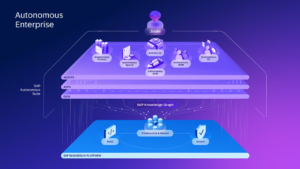
SAP’s strategy revolves around three connected layers:
| Layer | What it does |
| The Data Layer | Provides the governed AI, data, integration and knowledge foundation |
| Autonomous Suite | AI agents execute finance, procurement, HR and supply chain processes end to end |
| Joule Work | Users describe outcomes instead of navigating transactions and screens |
The ambition is straightforward: you tell SAP what outcome you want, AI agents coordinate the work behind the scenes, and every action stays auditable and governed.
The reality of it is that two of these three layers aren’t brand new technology. Business AI Platform is SAP BTP, renamed and given a much heavier AI focus, and the Autonomous Suite builds AI agents on top of applications many customers are already running, like S/4HANA, SuccessFactors and Ariba. If you’re already on RISE with SAP or actively using BTP, you likely have more of the foundation than SAP’s messaging suggests. The genuinely new part, and the one actually worth paying attention to, is Joule Work: the interface layer that changes how people interact with all of it.
It’s a compelling vision. Whether it’s a practical reality for most organisations right now is a different conversation, and one we’ll come back to.
How SAP’s Autonomous Enterprise actually works
1. SAP Business AI Platform: the foundation
Every autonomous system is only as good as the information it can trust, and SAP Business AI Platform is meant to be that trust layer. Truth be told, it’s just SAP Business Technology Platform, renamed and repositioned, not a brand new platform you need to go and buy. If you’re already on BTP, you already have the foundation. What’s changed is the emphasis, with a much heavier weighting now put on the AI and agent tooling sitting on top of it.
It brings together the data, integration and AI capabilities agents need to understand how your business actually operates, including business data, process relationships and the knowledge graph that gives agents organisational context.
It’s arguably the least glamorous part of SAP’s announcement, but it’s also the most important one. Without reliable data underneath it, autonomous decisions aren’t really decisions at all, they’re just automated mistakes, made faster.
Above: Building the foundations for something bigger.
2. The Autonomous Suite: where the agents live
The Autonomous Suite is the operational layer underneath all of this, and it isn’t a separate set of applications you need to implement from scratch. It’s AI agents layered onto SAP applications many customers already run, like S/4HANA, SuccessFactors and Ariba, taking on more of the process rather than replacing the system itself. Rather than suggesting tasks to employees, SAP wants those agents to complete them within predefined guardrails, across areas like:
- Finance and financial close
- Procurement
- Supply chain operations
- Human resources
- Customer experience
The shift here is subtle but significant. Traditional enterprise software has always helped people complete processes. The Autonomous Suite flips that around: it’s designed for AI to complete the process itself, with people remaining accountable for the outcome rather than doing the legwork.
3. Joule Work: changing the interface
Perhaps the biggest change here isn’t technical but behavioural, and it’s also the part of this announcement that’s genuinely new rather than repackaged. Joule Work moves users away from transaction codes, menus and complex navigation, and towards an interface that’s outcome-driven. Instead of working through screens, you simply say what you want:
“Prepare month-end close.”
“Resolve delayed purchase orders.”
“Create onboarding for our new regional sales team.”
Behind that one instruction, multiple agents coordinate the underlying workflow without you having to see any of it. That’s the experience SAP is ultimately selling, and unlike the platform and suite underneath it, it’s not something most customers already have any version of.
How is an Autonomous Enterprise different from RPA, agentic AI and intelligent automation?
This is where the terminology gets messy, so it’s worth untangling. Most automation vendors describe a similar progression, moving from rule-based automation through RPA and intelligent automation to agentic AI that can reason and coordinate work with less human input:
| Approach | What it automates | Can it reason? | Runs end-to-end processes? |
| Traditional automation | Repetitive rules | No | Limited |
| RPA | Screen-based tasks | Very little | Sometimes |
| Intelligent automation | Rules + ML | Somewhat | Partial |
| Agentic AI | Goals and reasoning | Yes | Often |
| SAP Autonomous Enterprise | Enterprise processes inside SAP | Yes | Designed to |
The underlying direction isn’t unique. Nearly everyone in enterprise AI is heading towards autonomous agents in some form. Where SAP is different is depth rather than breadth: it isn’t trying to orchestrate every application on earth, it’s building agents that understand SAP’s finance structures, procurement models and master data natively.
That’s both its greatest strength and its biggest limitation. If your SAP landscape is well governed, those agents inherit genuinely useful business context. If it isn’t, they inherit every weakness already sitting underneath it too.
What’s changed since Sapphire 2026?
One thing that convinced us this isn’t just marketing is what happened after the announcement. SAP didn’t simply launch a new phrase, it reorganised the business around it. Leadership responsibilities shifted, Business AI Platform became its own strategic area, the Autonomous Suite gained dedicated ownership, partner competencies were renamed, and AI foundation skills became central to future certification. Organisations don’t usually rewrite reporting lines and partner programmes within weeks of a keynote unless the strategy behind it is genuine, and that’s the good news.
It also means the tooling, certifications and delivery models are still evolving to catch up with the vision, which is normal for a strategy this size and not a reason to wait on the sidelines. It’s exactly why we think this is the right moment for organisations to start engaging with it properly, alongside a partner who’s tracking how it’s maturing, rather than trying to navigate a moving target alone.
The part that nobody selling SAP really wants to say out loud
This was the conversation we kept having internally while everyone else was talking about AI agents. Not once did one of our consultants say this is going to solve everything. Instead, they kept coming back to the same question: what happens when autonomous agents inherit a messy business? Because that’s the reality for most SAP customers, many of whom are still dealing with inconsistent master data, duplicated materials, unclear ownership of processes, integrations held together with workarounds, and governance that lives in people’s heads rather than in any documentation.
An AI agent doesn’t magically resolve any of that. It simply executes it faster. That’s the uncomfortable gap between SAP’s vision and customer reality, and it’s why we think the conversation has been slightly backwards. Everyone is asking whether they’re ready for AI. Far fewer organisations are asking whether their processes are ready for autonomy, and those are not the same question.
Is SAP’s Autonomous Enterprise actually achievable now?
Short answer: partly. Some elements are available today, particularly around Business AI capabilities built on BTP, which most existing customers already have some access to, and selected Joule experiences. Other parts of the Autonomous Suite are still rolling out, and partner certifications and delivery pathways will keep evolving into 2027.
For most businesses, this isn’t an all-or-nothing decision, and the smarter approach is to separate today’s foundations from tomorrow’s vision:
| Available today | Still maturing |
|---|---|
| Business AI capabilities (via BTP, already in place for many customers) | Full autonomous process execution |
| Early Joule experiences | End-to-end agent orchestration |
| AI foundation tooling | Mature delivery frameworks |
| Integration improvements | Industry-wide autonomous operating model |
That’s a much more useful planning conversation to have than asking whether you’re “doing Autonomous Enterprise” yet.
Are most organisations ready for it?
Probably not, and that’s not a criticism of the technology. It’s recognition that enterprise transformation has always been more about people than platforms. We’ve seen businesses dramatically improve productivity without introducing autonomous agents at all, and the common denominator was never better AI. It was clearer processes, stronger governance and better-designed ways of working.
SAP clearly knows this gap exists too. It’s backing a €100 million Business AI Partner-Led Adoption Incentive Program, offering up to €100,000 per approved project towards AI work delivered through an approved partner, specifically to get more customers moving. That’s a genuine incentive worth knowing about, but it funds the delivery of an AI project, not the data and process foundations that have to be in place first for that project to actually work.
Technology changes remarkably quickly. Organisations don’t. That’s been true whether the platform was called CPI, BTP or, now, Autonomous Enterprise, and it’s exactly the gap we spend most of our time helping SAP customers close before they go anywhere near a new platform.
What SAP doesn’t tell you about becoming an Autonomous Enterprise
Before investing in an autonomous operating model, we’d answer these questions first.
1. Is your master data trustworthy?
Agents can only make good decisions using reliable information. If your customer, supplier or material data is inconsistent, fixing that creates value on its own, regardless of which AI platform you eventually adopt.
2. Does every core process have a clear owner?
Automation doesn’t remove accountability, it just moves where it sits. If nobody owns procurement today, an AI agent running it tomorrow won’t magically create that governance for you.
3. Where does work actually break down?
Don’t start with AI, start with friction. Find the process people complain about every week, understand why it actually fails, and solve that before you go anywhere near an agent.
4. Are your people ready for a different way of working?
The biggest implementation challenge usually isn’t technical but behavioural. An autonomous enterprise changes how decisions get made, how exceptions are handled and what employees actually spend their time doing day to day. That makes it a people project before it’s ever a technology project.
Where should businesses start?
We’d keep it simple. Don’t start by asking which autonomous SAP product to buy, start by asking which painful business problem you’d actually want an agent to solve. Then work backwards: understand the process, clean up the data, establish ownership, identify the decisions that genuinely need a human, and put proper governance around it, before you even look at the technology.
That’s the order we work in with clients: people and process first, then finding the right technology to fit around them, rather than starting with a platform decision and hoping the rest falls into place. We’ve seen this work without an autonomous layer anywhere in sight. Brakes UK’s move towards a clearer, better-governed way of working cut training time by 26x and reduced screen interactions by 60 to 75%, and the important point wasn’t the technology at all, it was that the underlying process and data work had been done properly first. That matters even more once the next step is giving software permission to act on your behalf.
So, is the Autonomous Enterprise worth pursuing?
Yes, but probably not in the way the marketing suggests. The long-term direction makes sense, AI agents genuinely have the potential to remove a huge amount of repetitive operational work from enterprise teams. What we don’t buy is the idea that autonomy begins with installing another platform, not least because for most customers there isn’t really a new platform to install.
It’s a valiant vision from SAP, but one that’s a little disconnected from where most of its customers actually are. In our experience, becoming an autonomous enterprise begins much earlier than any platform decision: with clean data, clear ownership, well-designed processes, and a workforce that understands why the technology exists rather than just how to click through it. That’s been our approach at Bluestonex long before Autonomous Enterprise became this year’s headline. The platform will keep changing. People remain the constant.
Frequently asked questions
Is SAP Autonomous Enterprise the same as SAP Business AI Platform?
No. Business AI Platform (formerly SAP BTP, renamed as part of this strategy) is the foundation. The Autonomous Enterprise is the broader strategy built from the platform, the Autonomous Suite and Joule Work.
Do I need to buy a whole new platform to start becoming an Autonomous Enterprise?
No, not necessarily. Business AI Platform is SAP BTP renamed, so if you’re already using BTP or running applications like S/4HANA, SuccessFactors or Ariba, you already have a meaningful part of the foundation in place. The genuinely new piece is the Joule Work interface, and even that builds on capabilities SAP has been extending rather than launching from a standing start.
How is SAP Autonomous Enterprise different from RPA?
RPA generally automates individual, repetitive tasks. SAP’s Autonomous Enterprise aims to coordinate and complete entire business processes using AI agents with business context and defined guardrails.
Is SAP’s Autonomous Enterprise available now?
Parts of the strategy are available today, while other capabilities are still rolling out. Businesses should distinguish between the AI and Joule capabilities they can use now and the broader autonomous operating model SAP is building towards.
Should businesses invest in SAP Autonomous Enterprise now?
It’s worth preparing now, but preparation is less about buying software and more about improving data quality, governance and process clarity. Those foundations create value whether autonomous agents arrive next year or further down the road.
Getting there starts with small, well-chosen steps. For most SAP customers, the question today is which processes are ready for AI now and which need cleaner data or a cleaner core first. Our AI use-case discovery workshop works through that with your team and leaves you with a shortlist ranked by value and readiness.
Final thought
The phrase Autonomous Enterprise will probably become one of SAP’s defining ideas over the next decade, but whether it becomes one of yours depends less on AI and more on the foundations already sitting underneath your business.
That’s the conversation we think is worth having. If you’d like to talk through where your organisation actually stands against this, get in touch and we’ll have that conversation with you directly, specific to your business rather than SAP’s roadmap.

Jack Roberts
Marketing Executive