
Blogs
LEGO Serious Play: The Complete Guide
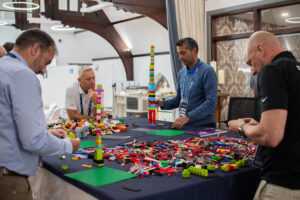
You’ve probably heard of LEGO Serious Play as “the thing where grown-ups build with LEGO in meetings.” That’s true, but it undersells what’s happening. This guide covers where it came from, why it works, what a real session looks like, and when it’s genuinely the right tool, not just a novelty.
What is LEGO Serious Play?
LEGO Serious Play, usually shortened to LSP, is a facilitated methodology for thinking, communicating, and solving problems, built around constructing physical LEGO models to represent ideas, then explaining and connecting those models as a group.
It isn’t team building in the “trust fall” sense, and it isn’t a creative warm-up exercise (even if sometimes it can be used in that way). It’s a structured process with a real methodology behind it, designed to get more of a team’s actual knowledge into the room than a normal meeting or workshop ever manages.
Where the LEGO Serious Play methodology came from
LEGO Serious Play was created in the mid-to-late 1990s through a collaboration between LEGO’s Robert Rasmussen and two professors at IMD business school in Lausanne, Johan Roos and Bart Victor. Initially developed to help the company’s own leadership think through strategy more effectively than a conventional meeting allowed, it was later refined into a formal methodology. In 2010, the LEGO Group made the core method openly available under a Creative Commons licence, which is why an entire global community of independent, certified facilitators now exists around it, coordinated today by the Association of Master Trainers in the LEGO Serious Play Method.
The LEGO serious play methodology is under the creative commons licence. Nobody owns exclusive rights to run LSP sessions, but the Association exists specifically to maintain quality standards, since the method is easy to run badly and hard to run well.
Why the LEGO Serious Play methodology works
The method rests on a thoroughly researched idea, not just “people like building things.” Hands are connected to a large share of the brain’s activity, and building something physical engages thinking in a way that regular conversation can’t. LSP calls this “hand knowledge”, the theory that constructing a model surfaces things a person wouldn’t have said if you’d just asked them the same question out loud.
The LSP methodology also flattens all social and enterprise hierarchies, allowing for everyone to participate no matter their social standing or seniority.
The method is also built on a specific set of beliefs about how organisations function well:
- Leaders don’t have all the answers, however senior they are.
- A team’s success depends on hearing every voice in the room.
- People want to contribute and take ownership, given a real chance to.
- Most teams operate under-optimally, with real knowledge sitting with people who never got asked properly.
The practical effect of this methodology is the change from what’s known as “lean backward meetings”, where engagement is low and people do not contribute, to “lean forward meetings”, where all participants are actively involved.

How a LEGO Serious Play session is structured
A real LSP session follows a structured core process, whatever the specific business question is. The full version has six stages, though how far a session goes depends on what the question actually needs.
1. Foundation: An introduction to the method, followed by simple skills-building exercises that “warm up” participants before anything serious gets built.
2. Content: Participants build individual models representing their own perspective, then work up to shared models that combine those views around the actual content of the challenge.
3. Landscape: The shared models get placed into a landscape together. Then “agents”, the internal and external factors that could influence what’s happening, get built and placed alongside them.
4. System: Connections get built between the agents themselves, and between the agents and the shared models, turning a static landscape into a working system.
5. Test system: The group looks for interesting patterns emerging from the system, then plays those patterns out to see what they actually reveal.
6. Simple Guiding Principles: The group builds candidate guiding principles, something like best practices for the system, then tests and selects the ones that genuinely hold up.
Some facilitators add a seventh stage, planning, translating the session’s conclusions into concrete plans or strategies. It’s a useful addition, but it isn’t part of the original LSP model.
Not every session runs the full six stages. Simpler challenges might stop at Content or Landscape; complex, systemic ones go all the way through to Test System and SGP. Sessions are always led by a trained facilitator, since the quality of the outcome depends heavily on how well the process is run, not just on having a box of bricks in the room.

When the LEGO Serious Play Methodology is genuinely the right tool
LEGO Serious Play is one of several techniques we use in our SAP discovery workshops. We choose the method that suits the problem and the people in the room, from building models to mapping a process on the wall or testing a clickable prototype.
It’s a strong fit for:
- Strategic decisions where a small/ medium-size group needs to align on a shared direction
- Surfacing disagreement that’s been left unspoken in normal meetings
- Complex problems with no single obvious right answer
- Situations where quieter or more junior voices tend to get talked over
It’s probably not the right tool for:
- A decision that’s already effectively made and just needs communicating
- A large audience where genuine individual participation isn’t realistic
- A purely technical problem with one correct, calculable answer
The LEGO Serious Play methodology in SAP and enterprise IT
Inside SAP projects specifically, the LSP methodology earns its place at exactly the moments where the real problem isn’t technical; it’s exploration and discovery. Getting business and IT stakeholders to agree on what a process should do before a single screen gets designed is a classic LSP use case. Physical models allow for healthy discussion in the room early in the process.
At Bluestonex, our AppHaus team uses the LSP methodology as part of our Design Thinking Workshops. It’s one of the best tools we reach for to get a room properly aligned before design work starts.
See how this fits into our Design Thinking Workshops
Frequently Asked Questions
Do I need special LEGO Serious Play kits, or will any LEGO work?
Purpose-built LSP kits exist and are commonly used, but the method itself is about the process, not a specific product. A trained facilitator can run a session with a well-chosen set of standard bricks.
Is LEGO Serious Play just for creative teams, or does it work for technical ones?
It works well for technical teams, because it forces a shared, concrete representation of a problem that’s otherwise easy to talk past each other about in abstract terms.
How long does a LEGO Serious Play session take?
It depends entirely on the complexity of the question. A focused session might run half a day; a genuinely strategic question can take one or two full days.
Do I need a certified LSP facilitator, or can anyone run one?
The method is open licence, so technically anyone can attempt it, but a trained LSP facilitator makes a tangible difference to the outcome. It’s easy to run an LSP session that just feels like playing with toys if it isn’t led properly.
Is this the same as Design Thinking?
Related, not identical. Design Thinking is a broader methodology (empathise, define, ideate, prototype, test); the LEGO Serious Play methodology is a specific technique that can be used within stages of that process, particularly where alignment and surfacing hidden disagreement matter most.

Joe Barton
AppHaus Coordinator