


Blogs
Recipe Management in SAP: How Food and Pharma Manufacturers Govern Formulation Data
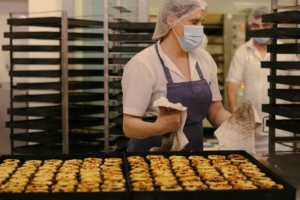
In food and pharma manufacturing, the recipe or formulation isn’t just a production instruction, it’s some of the most heavily regulated, commercially sensitive master data a business holds. Get it wrong and the consequences aren’t limited to a bad batch: they extend to failed compliance checks, product recalls, and in pharma, regulatory action. This guide covers how recipe and formulation data actually works inside SAP, and what governing it well looks like in practice.
What Recipe Data Actually Is in SAP
In SAP, recipe and formulation data doesn’t exist in isolation. It sits within Production Planning for Process Industries (PP-PI) as a master recipe, and it’s tightly linked to two other core master data objects: the material master, which holds the specifications, units of measure, and plant assignments for every ingredient and finished product involved, and the bill of materials (BOM), which defines what goes into the recipe and in what quantity.
That interdependency is exactly why recipe data is harder to govern than it looks. A master recipe is only as accurate as the material master records and BOM entries it depends on. Get a unit of measure wrong on a single raw material, and that error doesn’t stay contained to one record, it propagates directly into the recipe, and from there into every batch produced against it.
Why This Matters More in Food and Pharma
Standardising production, controlling cost, and enabling faster product development are all genuine benefits of well-governed recipe data, and they apply across most manufacturing sectors. But food and pharma carry an extra layer that makes recipe governance non-negotiable rather than a nice-to-have.
In food manufacturing, recipe data underpins allergen declarations, nutritional information, and Food Standards Agency (FSA) compliance. An incorrect ingredient or quantity in a master recipe isn’t just a quality issue, it’s a food safety and labelling issue with legal consequences attached.
In pharma, formulation data sits under an even stricter regime. The MHRA’s data integrity and Good Distribution Practice (GDP) requirements mean formulation and batch data need to be accurate, traceable, and auditable at every stage, from raw material sourcing through to the finished product. A discrepancy in formulation master data isn’t just an operational inconvenience in this context, it’s the kind of finding that shows up in an MHRA inspection.
Where Recipe Data Governance Breaks Down
The same failure patterns show up repeatedly across food and pharma manufacturers running SAP:
- Handover to manufacturing is manual and slow. Getting a recipe from product development into a usable master recipe in SAP often involves extensive back-and-forth, rework, and interpretation across teams that don’t share a system of record.
- Compliance checks aren’t integrated. Product compliance validation frequently happens outside the SAP landscape entirely, on spreadsheets or in separate systems, disconnected from the master recipe it’s supposed to be checking.
- Collaboration relies on manual workflow. Recipe developers, quality, and production teams often coordinate through email and offline documents rather than a shared, auditable system, which is exactly the kind of process that falls apart under regulatory scrutiny.
- Changes aren’t captured systematically. Scrappage, yield changes, and phase-in/phase-out updates to a recipe often go unreported in a way that could feed back into optimising the master data, so the same inefficiencies recur batch after batch.
Governing Recipe Data Properly
Fixing this comes down to treating the master recipe, material master, and BOM as a connected set of data that needs to move through a controlled, auditable workflow, rather than as separate objects maintained by separate teams with separate priorities.
In practice, that means:
- Workflow-based handover from product development into SAP PP-PI, with a system-enforced four-eyes check before a recipe reaches production, rather than relying on manual review to catch errors
- Automated linking between the master recipe and its dependent material and BOM records, so a change in one is reflected everywhere it needs to be, rather than requiring someone to remember to update three places
- Integration with SAP QM, so inspection and compliance checks happen alongside the recipe data itself rather than in a disconnected spreadsheet
- Integration with SAP CO, so costing implications of a recipe change are visible at the same time the change is made, not discovered later
- A single source of truth for recipe, material, and BOM data at the plant level, with clear local ownership rather than fragmented, informally-held versions of the same information
Getting Started
If recipe management is causing friction in your organisation, whether that’s slow new product launches, compliance checks that feel bolted on rather than built in, or recurring batch issues traced back to inconsistent master data, the fix starts with governance, not more manual process. For the wider principles behind this, see our manufacturing MDM hub, or our pharma MDM guide if formulation compliance is the specific pressure point.
Get in touch if you’d like to talk through what this looks like for your specific product range and plant setup.

Jack Roberts
Marketing Executive