
Webinars
Master Data Marathon 2.0: MDM Solutions

When: 24 June 2021
|Time: 11:00 am
Meet your Hosts
Who Ran This Session?

Dan Barton
Partner & Co-Founder of Bluestonex

What Is a Data Governance Strategy? A Practical Framework for Enterprise MDM
A data governance strategy is the structured set of policies, roles, processes, and technologies that an organisation uses to ensure its data is accurate, consistent, accountable, and fit for purpose across every system and business unit. Without one, master data — the foundational records that underpin ERP systems, reporting, and operational workflows — becomes fragmented, unreliable, and expensive to maintain.
Why Data Governance Strategy Fails Without MDM
Most organisations recognise the need for data governance in theory, but implementation falls apart at the point of execution. The most common failure modes are:
- Manual data entry with no enforcement layer. When data is captured through spreadsheets, email threads, or disconnected forms, there is no mechanism to validate accuracy at the point of entry. Errors propagate silently across downstream systems.
- Unstructured capture methods. Without standardised data models and defined data domains, the same entity — a supplier, a product, a cost centre — may be recorded in dozens of inconsistent formats across the business.
- Lack of transparent workflows. If data owners cannot see who changed a record, when, or why, accountability collapses. Governance becomes reactive rather than proactive.
- Technology-first thinking. Organisations frequently purchase an MDM platform and assume governance will follow. It rarely does. Technology without a supporting process model and trained data stewards produces the same poor-quality data, faster.
A Fit-for-Purpose Data Governance Framework: Identify, Plan, Deploy, Monitor
Effective data governance strategy is built around a repeatable, iterative lifecycle. The framework Bluestonex applies across MDM implementations consists of four phases:
1. Identify — Define your data domains (customer, supplier, product, asset, etc.), map the systems that own or consume those records, and document where data quality issues currently exist. This phase should produce a clear picture of scope before any tooling decisions are made.
2. Plan — Establish data ownership, stewardship roles, and accountability structures. Define the governance rules that will apply to each domain: mandatory fields, validation logic, approval workflows, and access controls. This is also where integration architecture is designed — how the MDM hub connects to ERP, CRM, and other systems of record.
3. Deploy — Implement the MDM solution in phases, starting with the highest-impact data domain. Solution validation workshops at this stage are critical: they surface edge cases, test business rules against real data, and give data stewards hands-on exposure before go-live. A hybrid agile deployment model — iterative sprints with defined acceptance criteria — significantly reduces implementation risk compared to a big-bang approach.
4. Monitor — Governance does not end at go-live. Define data quality KPIs (completeness, accuracy, duplication rate, workflow throughput) and instrument your MDM platform to report against them continuously. Governance rules should be treated as living artefacts, reviewed and updated as business processes evolve.
Process Over Technology: The Governing Principle
The single most important principle in data governance strategy is this: the process must precede the platform. An MDM solution enforces the rules your organisation defines — it cannot define them for you. Organisations that succeed with data governance invest heavily in the human layer: training data stewards, embedding governance into business workflows, and creating a culture of data accountability before — and throughout — the technology deployment.
Starting small is equally important. A phased approach that achieves measurable results in one data domain builds the organisational confidence and technical competence needed to scale governance across the enterprise. Early wins — such as eliminating redundant data entry forms, reducing duplicate supplier records, or improving data completeness scores — demonstrate business value and sustain executive sponsorship.
Selecting the Right MDM Solution
When evaluating MDM platforms to underpin your data governance strategy, prioritise the following:
- Process alignment — Can the platform model your specific workflows, approval chains, and data domain structures, or will your processes need to conform to the tool’s limitations?
- Integration capability — Does it connect natively to your ERP and core systems, or does integration require significant custom development?
- Scalability — Is the architecture designed to extend to additional data domains and higher data volumes as your governance programme matures?
- Human-centred design — Will data stewards and business users actually adopt it, or is the interface built for IT administrators?
- Vendor methodology — Does the implementation partner bring a structured deployment approach, or are you expected to define the methodology yourself?
The goal of any MDM solution is not to own your data governance strategy, but to operationalise it at scale.
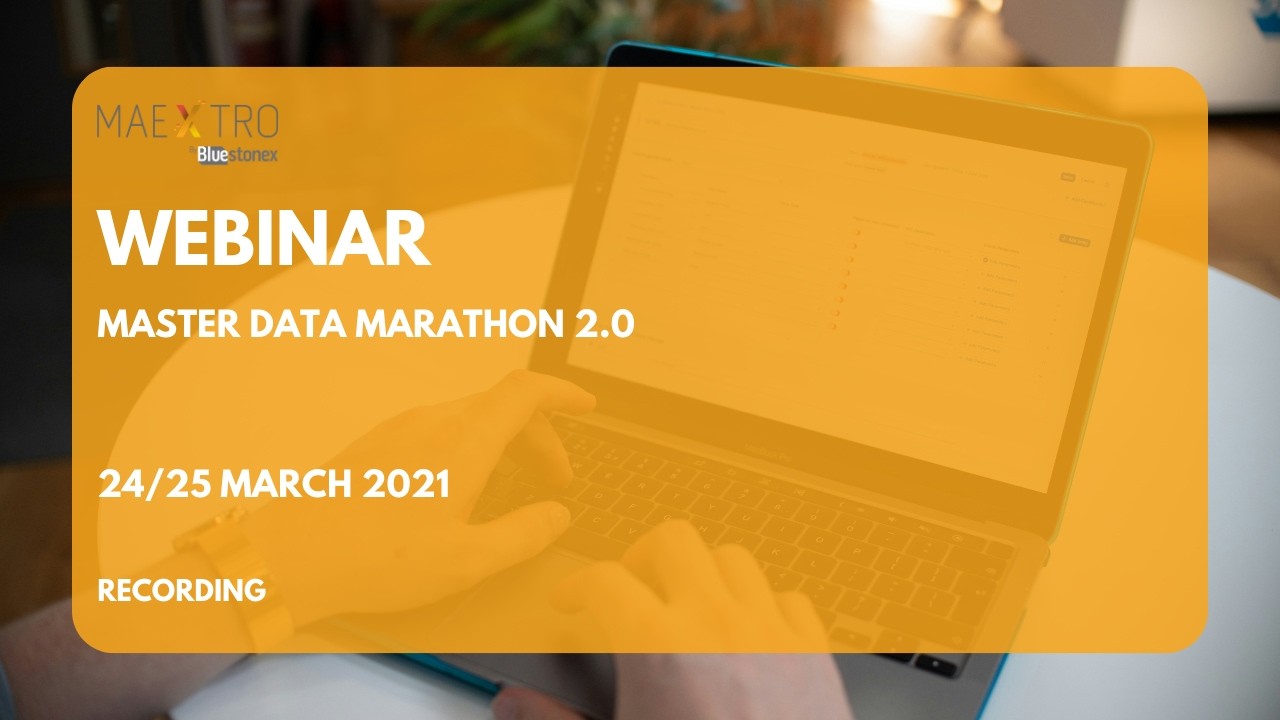
Want to see this framework in action? Watch the Master Data Marathon 2.0 webinar above, where the Bluestonex team walks through real-world MDM implementations, common governance pitfalls, and how the Maextro platform supports a structured, people-first approach to master data management.