

Webinars
Integrating S/4HANA with SAP Integration Suite | BTP-First S/4HANA Part 2
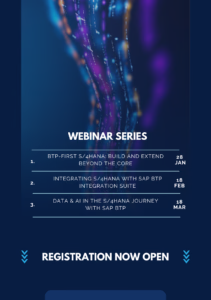
When: 18 February 2026
|Time: 11:00 am
Meet your Hosts
Who Ran This Session?

Yash Gokhale
SAP BTP Integration Consultant

Sabarinathan Chandrasekar
SAP BTP Integration Lead

Jack Roberts
Marketing Executive

Want to apply this to your own S/4HANA plans? Our BTP discovery workshop maps a BTP-first approach onto your landscape.
Integrating S/4HANA with SAP Integration Suite: A BTP-First Approach to Enterprise Connectivity
Integrating S/4HANA with SAP Integration Suite is one of the most consequential architectural decisions in any S/4HANA transformation. The modern enterprise runs on connectivity — between ERP and CRM, between core systems and partner portals, between SAP and the dozens of non-SAP applications that support end-to-end business processes. How that connectivity is designed, governed, and maintained determines whether an S/4HANA investment delivers its full potential or becomes constrained by a fragmented, brittle integration landscape.
SAP Integration Suite, delivered as a core service on SAP BTP, provides the cloud-native integration platform through which organisations can standardise and simplify that connectivity — replacing point-to-point integrations, legacy middleware, and manual data transfers with a managed, scalable, and centrally governed integration layer.
The Integration Challenge in S/4HANA Transformation
S/4HANA transformations — whether brownfield migrations, greenfield implementations, or staged hybrid transitions — almost universally surface integration complexity as a primary delivery risk. Existing integrations built for ECC or legacy landscapes frequently cannot be carried forward unchanged. APIs differ, data models change, and the move to a cloud or hybrid architecture introduces new connectivity requirements that on-premise middleware was never designed to handle.
Without a structured integration strategy, organisations address this complexity piecemeal — rebuilding integrations individually, creating new point-to-point connections, and accumulating a new generation of technical debt that will constrain the next transformation. With SAP Integration Suite at the centre of a BTP-first integration strategy, organisations have the opportunity to establish a scalable, standardised integration architecture that serves not just the current transformation but the enterprise’s long-term connectivity needs.
What SAP Integration Suite Delivers
SAP Integration Suite consolidates the capabilities required for enterprise integration into a single, cloud-native platform. Its core components address the full breadth of modern integration requirements:
Cloud Integration — the foundational integration capability, enabling message-based connectivity between SAP and non-SAP systems through pre-built integration flows, adapters, and mappings. SAP’s Integration Content Catalogue provides thousands of pre-built integration packages for common SAP-to-SAP and SAP-to-third-party scenarios, dramatically reducing the development effort required for standard integrations.
API Management — a full lifecycle API management capability, enabling organisations to publish, secure, monitor, and govern the APIs that expose S/4HANA data and processes to internal applications, partner systems, and external developers. API Management provides the control layer that makes API-led connectivity both secure and commercially viable at enterprise scale.
Event Mesh — an event streaming and messaging capability that enables asynchronous, event-driven integration patterns alongside traditional synchronous API connectivity. For high-volume, real-time integration scenarios — inventory updates, order status changes, financial postings — event-driven architecture delivered through Event Mesh provides the throughput and resilience that synchronous integration cannot.
Integration Advisor — an AI-assisted tooling capability that accelerates the development of B2B and A2A message mappings, reducing the specialist expertise required to build and maintain complex integration scenarios.
Trading Partner Management — purpose-built capability for managing EDI and B2B integrations with external trading partners, standardising connectivity with suppliers, customers, and logistics providers across common industry formats.
API and Event Management: The Architecture of Modern S/4HANA Integration
The shift from point-to-point integration to API and event-driven architecture is not simply a technical upgrade — it is a fundamental change in how enterprise systems communicate and how integration complexity is managed over time.
In a point-to-point integration landscape, every connection between systems is a direct dependency. When a system changes — when S/4HANA is upgraded, when a third-party application is replaced, when a new business requirement alters a data structure — every integration that touches that system must be reviewed and potentially reworked. The maintenance burden grows with every new connection, and the risk profile of any system change increases proportionally.
API-led connectivity, governed through SAP Integration Suite’s API Management capability, decouples systems from each other by introducing a managed API layer as the intermediary. Systems consume APIs rather than connecting directly — which means that when an underlying system changes, the API contract can be maintained independently, shielding consuming applications from the impact. This architectural separation is what makes enterprise integration scalable and maintainable over time.
Event-driven integration complements API connectivity by enabling systems to communicate asynchronously — publishing events when something of significance occurs, and allowing subscribing systems to react in their own time and context. This pattern is particularly powerful for S/4HANA scenarios where real-time data propagation across multiple systems is required without the tight coupling and latency risk of synchronous API calls.
Best Practices for Secure, Scalable S/4HANA Integration
Organisations building their S/4HANA integration architecture on SAP Integration Suite should apply a consistent set of design principles to ensure that the resulting landscape is secure, scalable, and maintainable:
Standardise before you build. Before developing custom integration flows, assess SAP’s pre-built integration content for the scenario. The Integration Content Catalogue covers the majority of common S/4HANA integration requirements — starting from pre-built content significantly reduces development time and produces more maintainable outcomes than bespoke builds.
Govern API access centrally. All APIs exposing S/4HANA data or processes should be published and governed through API Management, with consistent authentication, rate limiting, and monitoring applied regardless of the consuming application. Ad hoc API exposure outside the governed layer creates security risk and visibility gaps.
Design for change. Integration flows should be designed with versioning, error handling, and monitoring instrumented from the outset. Integrations that cannot be monitored cannot be maintained — and integrations that are not designed for change will become constraints as the business evolves.
Leverage event-driven patterns for high-volume scenarios. Where synchronous API integration introduces latency or resilience risk — particularly for high-frequency transactional data flows — evaluate event-driven alternatives through SAP Event Mesh before defaulting to synchronous connectivity.
Treat integration as a product. The most mature integration programmes manage their integration flows as versioned, documented, governed products — with clear ownership, change management processes, and lifecycle management. This discipline is what separates integration landscapes that scale from those that accumulate debt.
Accelerating S/4HANA Transformation With a BTP-First Integration Strategy
A BTP-first integration strategy does not simply replace existing middleware with a cloud equivalent — it establishes the connectivity foundation on which the entire S/4HANA transformation, and every subsequent extension and innovation, will depend. Organisations that invest in building this foundation correctly — with SAP Integration Suite as the central integration platform, governed API and event management practices, and a standardised approach to integration development — create a lasting architectural advantage.
Integration complexity is one of the most consistent reasons S/4HANA transformations run over time and over budget. A structured, platform-led approach to integration — delivered through SAP Integration Suite on BTP — is one of the most effective interventions available to project teams and IT leaders looking to manage that complexity and protect their transformation investment.