
Webinars
Data & AI in the S/4HANA Journey | BTP-First S/4HANA Part 3
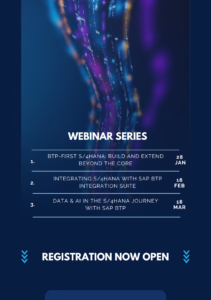
When: 18 March 2026
|Time: 11:00 am
As businesses accelerate their digital transformation, understanding how to effectively use modern data and AI capabilities has become essential. This session focuses on bridging that gap, showing how foundational data platforms such as SAP Business Data Cloud and AI innovations within SAP Business AI can work together to simplify complexity and drive better decision-making.
We also look at real-world applications, including how organisations are using these technologies to improve data quality through intelligent cleansing approaches, alongside a practical overview of tools such as SAP’s generative AI capabilities and Joule. Whether you are at the start of your S/4HANA journey or optimising an existing landscape, this session provides practical insight into making data and AI work for your business.
Meet your Hosts
Who Ran This Session?

Aditi Arora
Process Automation Lead

Sean Birnie
Business Development Manager (UK & I)

Vikash Kumar
SAP BTP AI Lead

Want to apply this to your own S/4HANA plans? Our BTP discovery workshop maps a BTP-first approach onto your landscape.
Data & AI in the S/4HANA Journey: How SAP Business AI Is Reshaping Enterprise Transformation
Data and AI in the S/4HANA journey are no longer future considerations — they are present realities that are reshaping how organisations plan, execute, and extract value from their SAP transformation programmes. The convergence of SAP Business Data Cloud, SAP Business AI, and the BTP platform layer means that the organisations migrating to S/4HANA today are not simply modernising their ERP system — they are building the data and AI infrastructure on which their next decade of enterprise capability will run.
Understanding what these technologies do, how they fit together, and where to start is the critical first step.
SAP Business Data Cloud: A Unified Enterprise Data Foundation
The SAP Business Data Cloud (BDC) represents SAP’s most significant step yet toward a unified enterprise data architecture. Built on SAP Datasphere and deeply integrated with SAP BTP, BDC brings together SAP and non-SAP data in a governed, semantically rich data foundation — making enterprise data accessible for analytics, AI, and decision-making in a way that fragmented, siloed data landscapes cannot support.
For organisations on the S/4HANA journey, BDC matters for a specific reason: the quality and structure of master and transactional data in S/4HANA determines the value that BDC — and everything built on top of it — can deliver. An S/4HANA system carrying duplicated vendor records, incomplete material data, or inconsistently structured financial hierarchies does not become a reliable data foundation simply by connecting it to BDC. The data quality work done during S/4HANA transformation is, in effect, foundational investment in BDC readiness.
Organisations that approach their S/4HANA migration with BDC in mind — designing data models, governance frameworks, and integration architecture with the unified data layer as the target state — will realise significantly more value from their BDC investment than those that treat the two programmes as separate.
SAP Business AI: The Intelligence Layer Across the SAP Portfolio
SAP Business AI is not a single product — it is an embedded intelligence capability that spans the SAP portfolio, surfacing AI-driven insights, recommendations, and automations within the business processes and applications where they are most relevant. For S/4HANA users, this means AI that operates in context: within procurement workflows, financial close processes, supply chain planning, and master data management — not as a separate tool requiring separate adoption.
Three components of SAP Business AI are particularly significant for organisations on the S/4HANA journey:
Joule — SAP’s generative AI copilot, embedded across S/4HANA and the broader SAP application suite. Joule enables natural language interaction with SAP systems — querying data, initiating processes, and surfacing insights through conversational interfaces — reducing the expertise barrier for complex SAP transactions and accelerating user productivity from day one.
The Generative AI Hub — a capability within SAP AI Core and SAP BTP that provides governed access to large language models and generative AI capabilities for custom application development. For organisations building extensions on BTP, the Gen AI Hub provides the infrastructure to embed generative AI into enterprise applications without managing model infrastructure independently — with SAP’s enterprise-grade security, data privacy, and compliance controls applied by default.
Embedded AI capabilities across S/4HANA — spanning intelligent document processing, predictive analytics, automated reconciliation, cash flow forecasting, and a growing catalogue of AI-powered process enhancements that improve operational efficiency without requiring separate AI tooling or data science resource.
AI-Powered Data Cleansing: A Real-World Application
One of the most immediately practical applications of SAP Business AI for organisations on the S/4HANA journey is AI-powered data cleansing. Master data quality is consistently the most time-consuming and resource-intensive workstream in any S/4HANA migration — identifying duplicates, completing missing fields, standardising inconsistent values, and resolving referential integrity issues across large, complex datasets.
Traditional approaches to data cleansing are manual, slow, and expensive. AI changes the economics materially. Machine learning models can identify likely duplicates across large vendor or customer datasets with a precision that manual review cannot match at scale. Generative AI can suggest completions for missing data fields based on context from adjacent records. Natural language processing can standardise free-text fields — material descriptions, address formats, contact names — that have been entered inconsistently across years of manual data entry.
The result is a data cleansing process that is faster, more consistent, and more thorough than what human review alone can achieve — producing a higher-quality data foundation for S/4HANA go-live, and a cleaner starting point for BDC and AI capabilities that depend on that data.
Where to Start: Practical Guidance for the S/4HANA and AI Journey
The breadth of SAP’s data and AI portfolio can make it difficult to know where to focus. Organisations that succeed in activating data and AI value during their S/4HANA journey share a common approach: they start with a clearly defined business problem, select the minimum set of tools required to address it, and build capability incrementally rather than attempting to activate everything simultaneously.
Practical entry points that deliver early, visible value include:
AI-assisted data cleansing during the migration preparation phase — addressing master data quality issues faster and more thoroughly than manual approaches, with measurable improvement in data completeness and accuracy scores before go-live.
Joule adoption within S/4HANA post go-live — accelerating user productivity and reducing support overhead by enabling natural language interaction with core ERP processes from day one.
Generative AI Hub pilots on SAP BTP — building one or two targeted generative AI applications against specific, bounded business problems, establishing internal capability and governance frameworks before scaling AI development across the enterprise.
BDC readiness assessment — evaluating the current state of master data, integration architecture, and data governance against BDC target requirements, identifying the gap and defining the roadmap to close it as part of the broader S/4HANA programme.
The Data and AI Advantage in S/4HANA Transformation
Organisations that approach their S/4HANA journey with data and AI as first-class workstreams — not afterthoughts — will emerge from transformation with a materially different set of capabilities than those that treat ERP migration as a purely technical exercise. The data foundation built during migration, the AI capabilities activated on BTP, and the governance frameworks established across master data domains are not just inputs to a successful go-live. They are the infrastructure of a more intelligent, more agile, and more data-driven enterprise.