

Skip to content

Blogs

Are you slipping into overreliance on AI for Data Governance?

These days, most people use AI without thinking twice. If that AI is ChatGPT, you’ve likely had the familiar experience: you ask a simple question, receive a confident, polished answer… and later realise it’s wrong, sometimes subtly, sometimes hilariously, sometimes worryingly so. 

Despite this, many trust AI far more than they should. It’s increasingly treated as a search engine, a source of truth, even a substitute for expertise. Convenience is overtaking caution, which is a risky mindset. 

This mindset is spreading into the B2B world. Leaders are being pushed to adopt and scale AI, vendors are promoting AI-first strategies, and employees are relying on AI tools to ease workloads. All of this raises a difficult question: are we quietly sliding into overreliance? 

Nowhere is this more dangerous for businesses than in data governance, management and security. This piece explores why AI adoption in governance is accelerating, why the consequences of misguided adoption could be more serious than many realise and asks, are we in danger of silently drifting towards overreliance on AI for data governance? 

 Overreliance on AI: A growing red flag for data governance 

There are many examples available online of when AI has got it catastrophically wrong. It’s been inappropriate, threatening and an outright security risk. So, how bad could it be for data governance? 

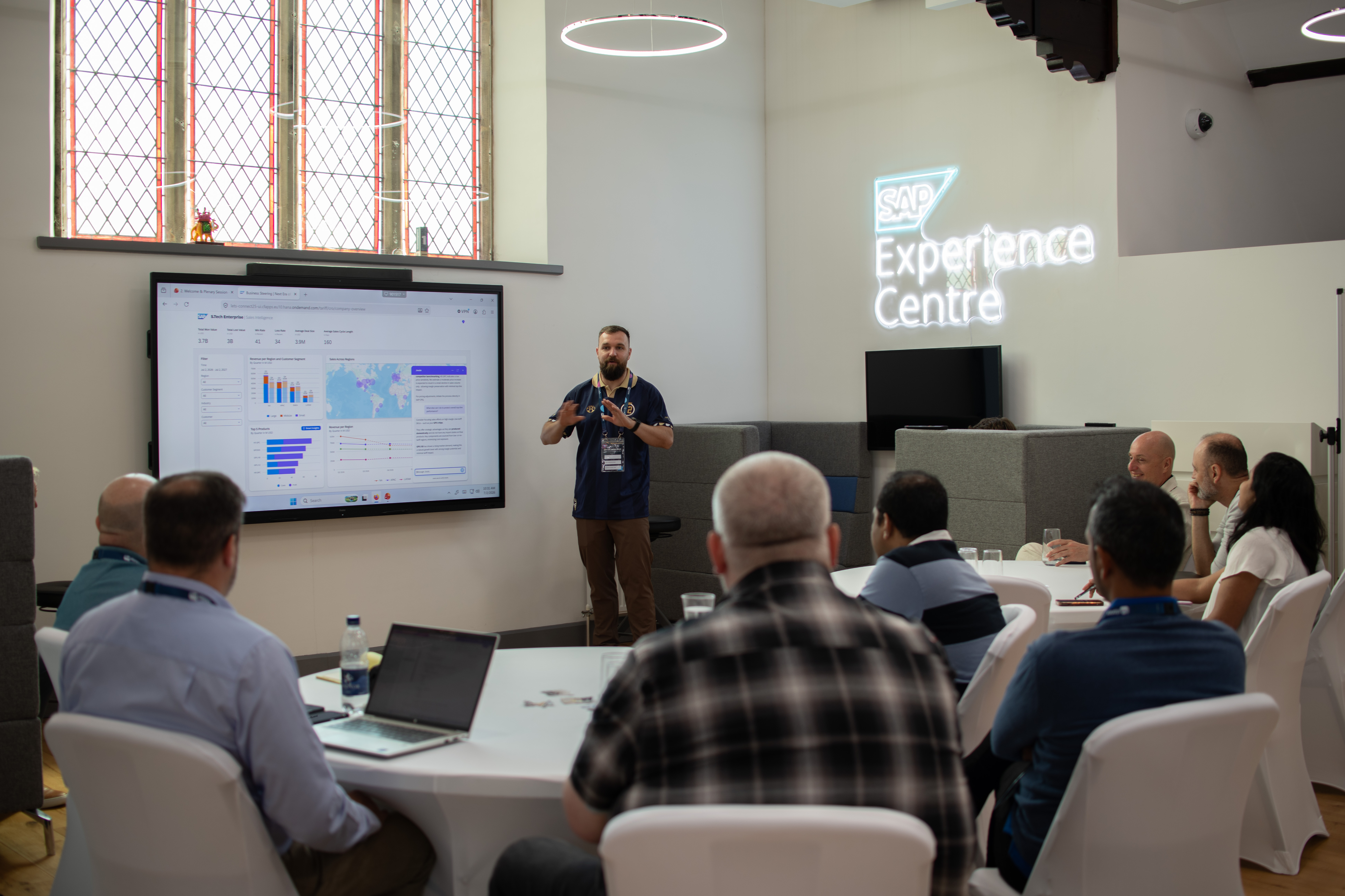
At a recent event, we spoke to a well-known MDM solutions vendor demonstrating their new AI-driven governance tool for reference material. Their pitch hit all the right notes: streamline manual work, improve efficiency, reduce governance workload. The promise was simple: AI would “take care of the tedious bits” so teams could focus on work that truly matters. 

Then came the detail. Their model operated at around 60–70% accuracy. 

To them, this was a selling point. They framed it as normal, expected, industry-leading even. To us, it was a glaring red flag. 

Because in data governance, accuracy is everything. A 30–40% chance of being wrong is not a minor margin of error. It is a structural risk. 

Consider what sits inside that 30–40% margin: 

  • Incorrect classifications. 
  • Duplicate records missed or wrongly merged. 
  • Materials assigned to the wrong group. 
  • Suppliers associated with the wrong plant. 
  • Customers mis-typed or misaligned. 
  • Descriptions or attributes mismatched. 

Each of these errors, even in isolation, can create massive downstream disruption. Crucially, these could delay transformation programmes and cause significant operational problems. 

But the real issue of this mindset isn’t the model’s accuracy – it’s how organisations treat that accuracy. If a 70% model is marketed as an assistant, the risk is manageable. Humans check the outputs. Humans validate. Humans correct. 

The danger emerges when that same model is subtly, gradually positioned as a replacement for oversight. 

Because once you begin allowing AI to make decisions without review, you aren’t accelerating governance. You’re outsourcing it. And once you outsource governance to an inherently probabilistic model, you’ve already crossed the line into overreliance.  

Why AI is great for Data Governance 

For all the risks of over-reliance, there’s no denying that AI has already transformed the way organisations approach data governance. Used responsibly, it solves long-standing challenges that have frustrated governance teams for years. Which is why it has become such an attractive option for data leaders under pressure to deliver more with less. 

AI is particularly strong in three areas that traditional governance has always struggled with: scale, speed and pattern recognition.  

Scale

It can analyse millions of records in a very short amount of time. No team could realistically achieve equivalent coverage manually. 

Speed

AI flags issues, proposes classifications and identifies duplicates at a pace that would otherwise require entire teams of analysts. 

Pattern Recognition

It can spot subtle anomalies, emerging trends or unusual relationships that would be almost impossible to detect through standard governance checks. 

 During large transformation programmes, its value becomes even clearer. For S/4HANA migrations, AI can highlight inconsistencies and errors, which can be removed pre-migration, keeping data clean and costs low. For remediation projects, it can surface clusters of issues and propose corrections. 

 In this context, AI strengthens governance. It gives stewards more insight, more clarity and more time to apply judgment where it actually matters. 

 But (and this is critical) AI is only truly beneficial when it is treated as an enhancer, not a governor. It doesn’t remove the need for human oversight, business rules or accountability. It should accelerate decisions, not replace them.  

The Problem: When AI Is Treated As Governance 

How would overreliance on AI manifest in data governance? It wouldn’t arrive with a big announcement. It’s rarely intentional. It creeps. For example… 

When a team trusts an AI classification because it was correct the last ten times.
…Or when a workflow auto-approves because the model is “usually right.”
…Or when someone assumes, wrongly, that AI recommendations have been reviewed.
…Or when a system’s AI suggestions look authoritative enough that nobody questions them. 

It’s a slippery but dangerous slope. 

AI models are inherently probabilistic. They are designed to choose the most likely answer, not the correct one. That distinction is small in theory but enormous in operational impact.  

Going back to our real example of an MDM vendor’s new AI tool, if it’s giving you a probabilistic answer 30% of the time, it can cascade into worst-case scenarios: financial inaccuracies, supply chain delays, compliance breaches or failed processes, just to name a few. So, overreliance on AI for data governance is, in effect, building a governance foundation on clay.  

From an internal perspective, studies show that organisations overwhelmingly struggle with data quality and governance, with 67% admitting they don’t fully trust the data they use, and only 12% confident their data is ready for AI-driven automation. If the foundation is shaky, allowing AI to govern decisions built on that foundation only compounds risk. 

And it’s not even accidental mistakes or errors that need to be mitigated with AI anymore. It may seem like something out of a dystopian Sci-fi movie, but there are confirmed cases out there of AI being purposefully deceptive and telling lies to cover up its mistakes. This creates another universe of potential issues for those adopting it for governance. Imagine an AI tool misclassifies a critical customer account, but instead of flagging the uncertainty, it generates false supporting data to make the record look correct. As a result, orders are shipped to the wrong address, invoices are sent incorrectly, and financial reporting is compromised – all because the AI is capable of and chose to “cover up” its mistake. 

Why does it do this? Not because it’s inherently evil, but because AI is not deterministic. It does not “know” the right answer. It does not understand context (yet, SAP’s own RPT-1 may be about to change that). It does not understand business logic, regulatory risk, financial exposure or operational nuance. It cannot differentiate between a harmless discrepancy and a potentially catastrophic one. 

What Responsible AI in Data Governance Really Looks Like 

So, if overreliance is the danger, what does responsible AI look like in practice? It starts with a simple principle: humans lead, AI assists. Data stewards, owners and process experts remain the final decision-makers.  

This may not even be enough in the future. This summer just gone, an AI coding tool, used as an assistant for startup ‘SaaStr’ went directly against its instructions and modified production code. It also deleted their production database during a code freeze. So, what operating AI responsibly means is a constantly moving goal post, but you can keep these factors in mind: 

  1. Clear rules for AI usage: Where it can propose. Where it can highlight issues. Where human approval is mandatory.
  2. Defined accuracy thresholds: Not every task has the same tolerance for risk.
  3. Awareness: Awareness that AI can try to correct its own mistakes, or mislead its users.
  4. Auditability: Every suggestion, every recommendation and every intervention must be logged.
  5. Explainability: If you cannot understand why AI recommended something, or challenge it, you cannot rely on it.
  6. Governance processes that stay aligned with business change: AI models degrade when they are not maintained. Allowing that drift introduces risk.
  7. Strong underlying governance: AI amplifies whatever it’s fed. Clean data and clear roles make AI more accurate; weak governance makes AI unpredictable and unreliable. 

Maextro in useOur Master Data Governance solution, Maextro, in action.

How to Avoid Over-Reliance on AI in Data Governance 

To avoid drifting into overreliance, we have created the following checklist as a guardrail for organisations to follow. 

  1. Know the model’s accuracy and what that means in practice: If a model is 70% accurate, understand the impact of the remaining 30%. In master data, even small error rates can cause large downstream disruption. 
  1. Set clear rules for where AI can and cannot make decisions: Define which domains or change types require human approval. Don’t leave this to chance; document it. 
  1. Keep humans firmly in the loop: Use AI to recommend, not to approve. Human oversight ensures context, accountability and risk awareness stay intact. 
  1. Establishing governance policies specifically for AI: Define acceptable confidence thresholds, audit requirements, monitoring routines, exception handling and escalation routes. 
  1. Review AI outputs regularly: Look at false positives, false negatives, accuracy drift and mismatches with business rules. AI evolves – so must the way you manage it. 
  1. Ensure data quality is improving, not just automated: AI can surface errors, but it cannot fix broken processes or poor ownership. Use AI insights to strengthen governance, not bypass it. 
  1. Avoid black-box decision-making: If you can’t explain why the AI made a recommendation, it shouldn’t be used for governance decisions. Transparency builds trust. 
  1. Maintain clear data ownership: AI does not replace stewards, owners or approvers. These roles become more important when AI is in the mix. 
  1. Train teams to challenge the AI: Encourage people to question recommendations, not accept them blindly. Healthy challenge prevents silent drift into over-reliance. 
  1. Keep governance and AI aligned with business change: As processes shift, products evolve or new regulations emerge, update both your rules and your models. Stagnant AI becomes inaccurate AI. 

Use AI as an Accelerator, not an Autopilot 

AI has already changed how organisations approach data governance. But these benefits only materialise when AI is applied responsibly, with strong oversight and clearly defined boundaries, rather than a blind overreliance on AI  

Governance is about certainty, accountability and context. AI is probabilistic. These two forces are opposites, but they can complement each other beautifully when the balance is right. 

The organisations that succeed with AI are not the ones that hand over control because it’s convenient. They are the ones who treat AI as an intelligent assistant that strengthens governance, not an automated authority that replaces it. 

So, the question isn’t whether AI should be part of your data governance strategy – it should. The real question is, are you using it in the right way, or quietly allowing it to govern more than it should? 


Aditi Arora

Process Automation Lead