


Blogs
SAP TechEd 2025 Keynote Decoded
SAP TechEd 2025 delivered exactly what SAP users around the world have been waiting for: a bold, practical look at how AI & data are converging to supercharge how business runs. With the debut of SAP’s own large language model RPT-1, to new AI-driven developer experiences that literally make coding “a vibe” (how millennial!), TechEd 2025 set a clear direction: the intelligent enterprise is no longer a vision; the revolution has arrived.
In this blog, we will be looking beyond the hype (and slightly awkward applauses) to break down the biggest announcements, explain what they actually mean in simple terms, and highlight why they matter for anyone building on, working with, or relying on SAP technology today.

SAP-RPT-1
SAP RPT-1 is SAP’s new large language model – essentially SAP’s version of ChatGPT, but built specifically for business data and SAP systems. The name reflects its core strengths: it’s Relational (understands structured business data), Pre-trained (on massive GPU hours so users don’t have to), and Transformative in how it enables AI across the enterprise.
SAP claims it’s one of the most capable predictive models available today – a bold claim, but one they’re already backing with strong performance metrics. What sets RPT-1 apart is its ability to work directly with tabular data, something most LLMs struggle with. This unlocks genuinely powerful predictive capabilities that help users make better, faster decisions.
Traditionally, implementing AI meant building and training separate models for each use case. If you needed 100 predictive tools, you would build 100 models. RPT-1 changes that. It replaces countless individual models with one central model that only needs minimal data to start producing value. For data teams under pressure to “deliver AI yesterday,” this is a huge productivity win, and the shared context improves accuracy while keeping everything inside SAP’s trusted environment.
SAP’s real-world example makes showed one of its many applications: RPT-1 analysed a sales pipeline and predicted which open deals were most likely to close, helping a sales team prioritise its efforts. All the data powering this sits in S/4HANA Cloud, making RPT-1 an easy way to get more value out of S/4HANA without specialist expertise. Expect to see it replace many existing predictive models as an AI that can hit the ground running.
RPT-1 will be available in three versions:
- Small – Optimised for ultra-fast predictions
- Large – Optimised for high security
- Open Source – Available for everyone to use and learn
Collab with Snowflake

The second headline for SAP TechEd 2025 was the announcement that SAP and Snowflake are working together and releasing an extension for companies to easily bring SAP data into Snowflake and combine it with other enterprise data. This will make computing and storage for data and AI workloads much more flexible for SAP users, and retain the governance and business context of SAP. This means no more complex pipelines or exports, simplifying the way SAP users make analytics and can make AI agents. Data engineers will be especially pleased by this as there’s less manual work to do, but your AI models, dashboards and analytics will all get a supercharge.
In reality, it seems like Business Data Cloud ‘plus’, using Snowflake to backfill the AI element to BDC. This will make BDC the most context-rich agentic platform. Ready to use, ready to extend, so it’s AI with out-of-the-box value baked in, yet plenty of customisation and ability to build from scratch as well. Ideal for accelerating business warehouse modernisation.
Vibe Coding
Speaking of building from scratch or retaining out-of-the-box value, SAP announced (The surprisingly well-named for them) ‘Vibe coding’. Vibe coding is a jazzed-up natural language coding assistant inside SAP Build and SAP developer tools for pro-code developers that meets them where they have skills and are comfortable. The developer tells it what it wants, and it generates the code, automations or workflows.
SAP have claimed it’s as good as a co-developer and there’s no denying this is a great step forward in unifying the coding community, regardless of how they work best, whether it be UX, logic-based based or other. Developers that embrace Vibe Coding can expect to see faster development, a reduction in repetitive coding tasks and a newfound openness of app building for non-experts.
LoB agent development and building
A combination of the aforementioned announcements culminates in SAP enabling companies to build their own specialised AI agents for a variety of business functions- HR, Finance, Supply Chain and beyond.
There’s no end to the applications of agentic AI, with SAP already having 2,100 skill sets created. A few examples include:
- A Finance agent that explains variances
- An HR agent that answers employee questions
- A Supply Chain agent that predicts delays
Additionally, users will be able to extend existing agents by training them on existing documents, instructions for processing and pre-imposed reasoning, wrapping the agent in business context and giving them access to well-made agentic AI that moulds to their specific business requirements.
Perhaps most importantly, the AI agents will have baked in accountability and traceability across all agents and their actions with agent mining on Signavio. This means SAP users will be able to see exactly what an AI agent did, why it did it, and how it affected a business process.
The Governance Gap that needs to be addressed
SAP summed it up well: “Every enterprise is becoming a data company, every user experience is becoming AI-driven.” The foundations for agentic AI are here, but (and it’s a big but) all the excitement around copilots and automation ignored the factor that determines whether any of this actually works: data governance. Yet, governance barely got a mention at TechEd this year, and when it was, it felt like an afterthought tacked onto the end of the pitch. For something this critical, that’s not good enough.
Why governance is the real gap
It comes back to the simplest principle in tech: GIGO—Garbage In, Garbage Out. If your data is inconsistent, incomplete, siloed, or poorly owned, the smartest AI will still produce unreliable or misleading outputs. Intelligence doesn’t compensate for bad foundations.
Consider RPT-1. SAP is positioning it as the single LLM powering every agent and generative capability. But that also makes it entirely dependent on the quality of the business documents, processes, and configurations it consumes. If that data is wrong, every agentic action built on RPT-1 will also be wrong, turning it from a multiplier of value into a multiplier of mistakes. Developers end up checking every output manually, defeating the very purpose of having a central AI model.
It would be like spending a fortune on an engine upgrade for your diesel car, with these ‘turbochargers’ and then putting petrol in the engine. It doesn’t matter how powerful the upgrade is; the system simply won’t run. Without a strong data governance solution in place, RPT-1 could become a single point of failure.
Before any organisation adopts the new wave of SAP AI capabilities, the first conversation should be about governance, not as an afterthought, as it was presented in the keynote.
Check out a recent webinar we hosted on data governance strategy and execution for more information on how to get data governance right.
Are these really worth the applause?
In short, we’re happy to say yes, for developers, these announcements will be genuinely welcome. Many organisations are already experimenting with open-source agents, so bringing similar capabilities directly into the SAP ecosystem simply makes life easier and far more efficient.
Unlike previous years, these innovations feel more practical than hype. They offer real, tangible business value and promise major efficiency gains, turning tasks that once took months into work that can be done in days. If SAP can deliver on that, why wouldn’t teams take advantage and reclaim their time?
Closing thoughts
SAP appears to be repositioning its tools not just as accelerators for employees, but increasingly as substitutes for employee-led work. The message for 2026 is clear: this next wave is about empowerment and outcomes, not experimentation for its own sake. SAP is finally delivering the kind of practical, business-ready value customers have been asking for.
If you’re ready to start baking AI into your applications (with governance sorted), now is the time. The tools are here, they’re strong, and they’re built to integrate into real development workflows. But they also come with a shift in expectations. Development will need to be deeper, faster, and more AI-driven. Those who lean into this shift by upskilling, experimenting, and learning to coexist with AI will thrive. Those who don’t may find themselves falling behind.
The best way to stay ahead is simple: get hands-on. Explore the tools, test the agents, and build with the new capabilities. The successful developer of the future won’t be replaced by AI – they will collaborate with it.
The Modish Exchange X Bluestonex
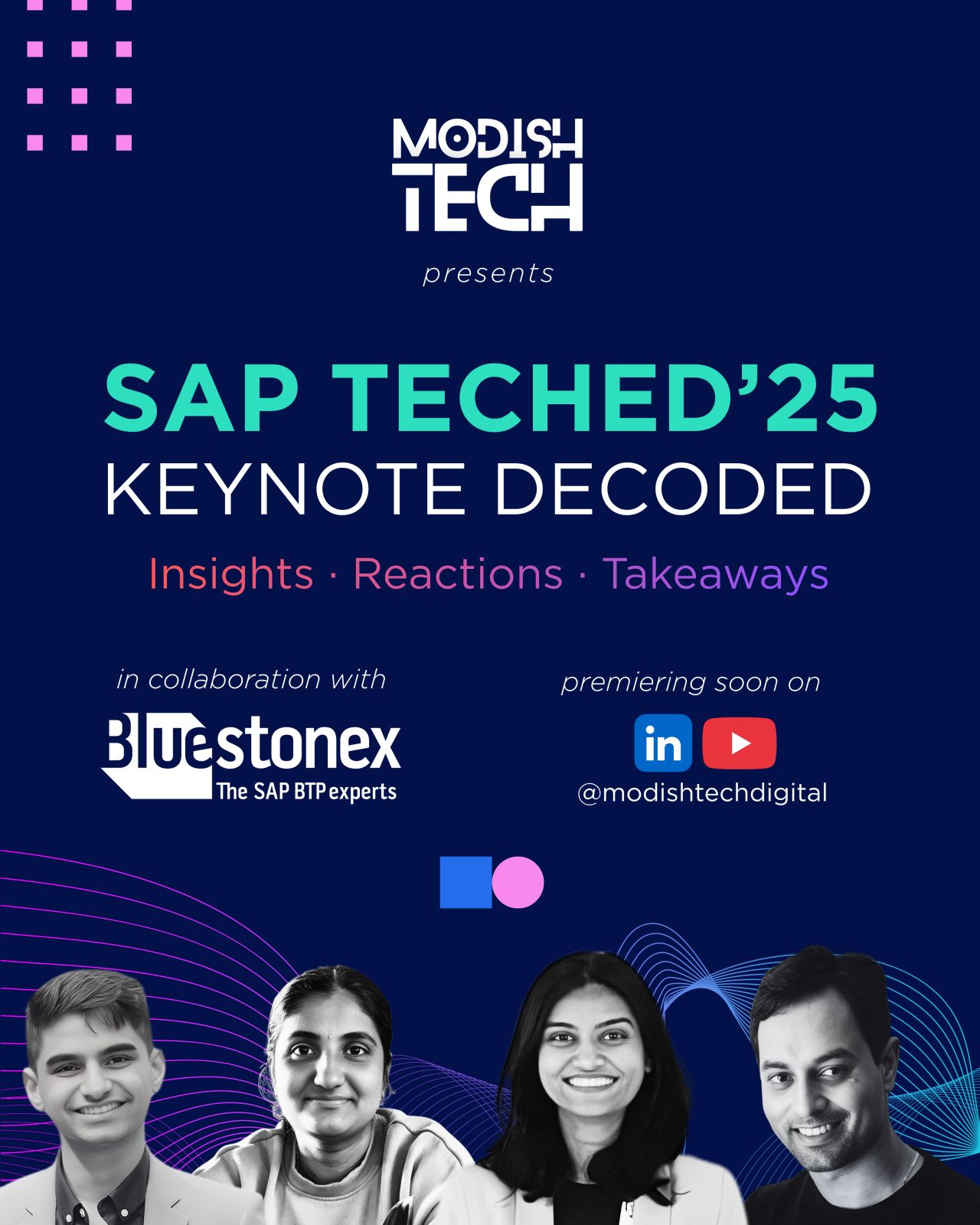
Bluestonex have joined Modish Tech for a special premiere! Join Vikash Kumer, Aditi Arora, Soumya Sharma and Yash Gokhale for all the insights from SAP TechEd 2025 Keynote.
Watch the full video for:
- Highlights from the SAP TechEd 2025 Keynote
- Our expert panel’s insights and real-time reactions
- Key takeaways for developers, architects, and businesses
- What’s next for SAP BTP, AI, and digital transformation

Vikash Kumar
SAP BTP AI Lead
